
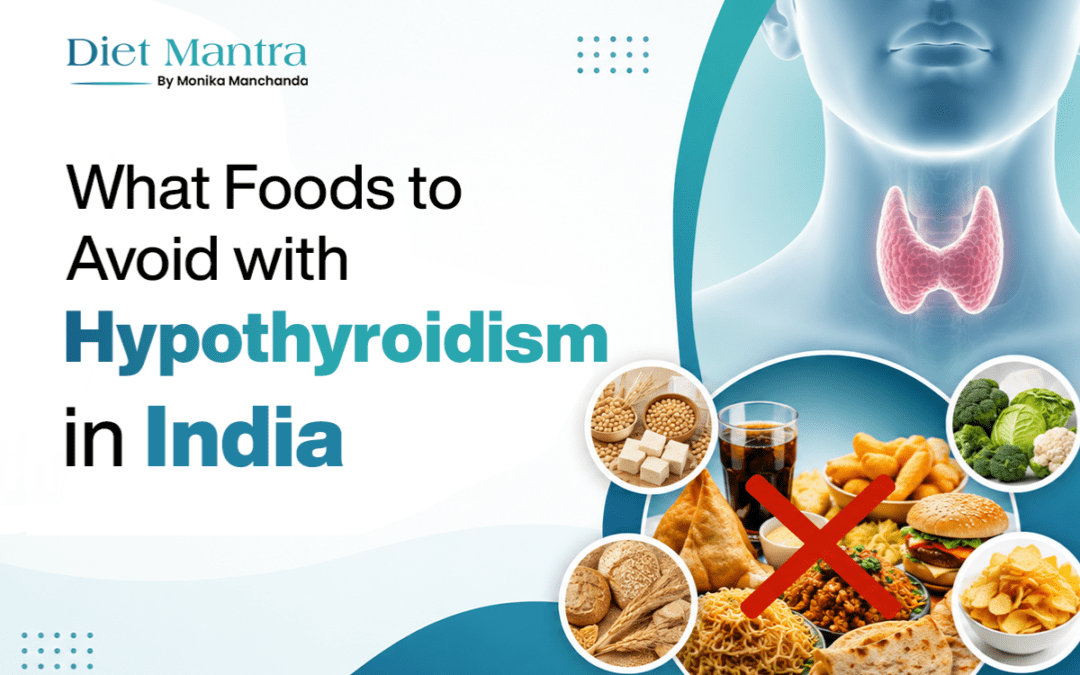
What Foods to Avoid with Hypothyroidism in India
Getting a hypothyroidism diagnosis feels overwhelming at first. Your doctor gives you a prescription, maybe mentions something about “being careful with your hypothyroidism diet,” and that’s pretty much it. You come home, open Google, and suddenly you’re drowning in advice that talks about kale smoothies and quinoa bowls none of which has anything to do with how you actually eat.
If your daily meals look anything like dal-chawal, sabzi-roti, evening chai with biscuits, and the occasional aloo paratha on weekends this one is for you.
India has one of the highest rates of thyroid problems in the world nearly 1 in 10 Indians has some form of thyroid disorder, and hypothyroidism tops the list. Yet almost no India-specific hypothyroidism diet advice exists. Let’s fix that.
Diet Mantra by Monika helps in managing Hypothyroidism with Practical Diet Plans based on Indian Eating Habits.
First, Why Does Food Even Matter Here?
Your thyroid makes two hormones T3 and T4 that quietly control everything from your weight and energy to your mood, sleep, and how fast your body burns calories. When your thyroid is sluggish, certain foods can make it even harder for it to do its job. Some block iodine absorption. Others interfere with your medication. A few do both.
The thing is, you don’t need to overhaul your entire diet. Small, informed changes go a long way.
Foods to Avoid with Hypothyroidism in India
1. Goitrogenic Vegetables Yes, Including Your Favourite Gobhi
I know. This one hurts a little.
Goitrogens are compounds found in certain vegetables that interfere with iodine absorption and slow thyroid function. And unfortunately, some of the most commonly eaten vegetables in Indian kitchens fall into this group cabbage (patta gobhi), cauliflower (phool gobhi), broccoli, mustard greens (sarson ka saag), radish (mooli), and turnip (shalgam).
Before you ban gobhi from your kitchen forever, here’s the important part: cooking these vegetables reduces their goitrogenic effect by around 30 to 50 percent. So a hot, well-cooked aloo gobhi sabzi a couple of times a week is very different from munching raw cabbage in a salad every single day. It’s daily raw consumption in large amounts that causes trouble not the occasional cooked portion.
2. Soy The Hidden Thyroid Disruptor
Soy has crept into the Indian diet more than most people realise. Nutrela soy chunks in your curry, soy milk in your protein shake, tofu in your stir fry it adds up quickly. Soy contains compounds called isoflavones that can interfere with thyroid hormone production. More importantly, soy reduces how well your body absorbs levothyroxine, which is the thyroid medication most people with hypothyroidism diet take every morning.
The solution isn’t to never eat soy again. It’s simply to not eat a soy-heavy meal within 3 to 4 hours of taking your medication. Timing matters far more than elimination here.
3. Bajra and Jowar Eat Smart, Not Obsessively
Millets are genuinely good for most people. But bajra (pearl millet) and jowar (sorghum) contain mild goitrogenic compounds, and when you go all-in bajra roti every single meal, every day it can start affecting your thyroid over time.
Nobody’s saying avoid them. Just don’t make them your only grain mix in wheat, rice, and ragi through the week.
4. Packaged Snacks and Processed Foods
Namkeen, biscuits with chai, instant noodles all loaded with sodium, refined flour, and preservatives. For hypothyroid patients, excess sodium directly worsens water retention and weight gain, two symptoms you’re probably already fighting.
Also worth knowing: many packaged Indian snacks use soy as a filler ingredient. It rarely shows up prominently on the front of the pack. Get into the habit of flipping it over and checking the full ingredient list.
5. Your Morning Tea: The Timing Problem
Okay, nobody is telling you to give up chai. Let’s be very clear about that.
Drinking chai right after your thyroid medication reduces how much of it your body actually absorbs. Calcium in milk is the main culprit, and caffeine makes it worse. Your medication needs a clear window ideally 30 to 60 minutes before anything with milk or caffeine.
So the rule is simple: take your medication first thing, wait at least half an hour, then enjoy your chai in peace. That’s it.
6. Too Much Iodine
Here’s one that surprises people. Everyone knows iodine deficiency causes hypothyroidism so it seems logical that loading up on iodine would help. But your thyroid is more sensitive than that. Excess iodine can actually suppress thyroid function, something doctors refer to as the Wolff-Chaikoff effect.
In practical terms: don’t overdo iodized salt, and be cautious with health supplements like kelp and spirulina, which are extremely iodine-dense. These are trendy right now in urban wellness circles, but for someone with hypothyroidism, they can do more harm than good without medical guidance.
7. Gluten If Hashimoto's Is in the Picture
If your hypothyroidism is caused by Hashimoto’s thyroiditis, which is an autoimmune condition, then gluten deserves a separate conversation. There’s growing evidence that gluten can trigger inflammation in people with autoimmune thyroid disease and make the condition harder to manage.
Going gluten-free in India is genuinely hard roti, paratha, naan, and maida snacks are staples. It may not be necessary for everyone. But if Hashimoto’s is confirmed, ask your doctor about dialling back gluten gradually.
8. Alcohol
Alcohol suppresses thyroid hormone production, worsens fatigue and brain fog, and disrupts sleep three things hypothyroid patients already struggle with. If you do drink, keep it light.
What Your Thyroid Actually Needs?
Your thyroid needs a thyroid diet chart. Here’s what actively helps: eggs, pumpkin seeds, and sunflower seeds for selenium and zinc; moderate iodized salt and dairy for iodine; turmeric and ginger for anti-inflammatory support; and Vitamin D, since many Indian hypothyroid patients are deficient without even realizing it so thyroid diet chart is very important.
And dal moong, masoor, toor is completely fine. Eat it every day if you want. It’s actually good for you and to cure your thyroid.
People Also Ask
Can I eat rice with hypothyroidism? Yes. Rice isn’t the problem. Pair it with dal, sabzi, and curd the way most Indians naturally do, and you’re already eating a reasonably balanced meal. The concern is just portion size, since metabolism tends to be slower with hypothyroidism.
Is dahi safe with hypothyroidism? Absolutely. Curd is beneficial protein, probiotics, calcium. Just don’t have it right after your morning thyroid pill.
Are Indian spices okay? More than okay. Haldi, jeera, ginger, and methi are anti-inflammatory and genuinely supportive for thyroid health, especially if Hashimoto’s is involved.
Can I eat amla? Yes, freely. Amla has Vitamin C, supports immunity, and has no goitrogenic activity at all.
How long after my thyroid pill can I eat? Wait at least 30 minutes, ideally 45 to 60, before eating especially if dairy, soy, or high-fibre foods are involved.
To Wrap It Up
Living with hypothyroidism in India doesn’t mean giving up the food you love. It means being a little more thoughtful about timing your medication, about not going overboard on raw goitrogenic vegetables, and about reading labels on packaged food and with hypothyroidism diet it is . That’s genuinely it.
Cook your gobhi. Have your chai. Eat your dal. Just let your medication do its job first thing in the morning before anything else gets in the way.
This content is informational only. Please speak to your doctor or a registered dietitian for guidance specific to your health needs.
If you want to enquire you can contact (+91)9818565756 or email info@dietmantrabymonika.in
Follow- instagram
Recent Comments